A Morning News Routine in 10 Minutes
A morning news routine should give you the day, not take it. Four rules that keep the first ten minutes to orientation, and the test that says it worked.
Published
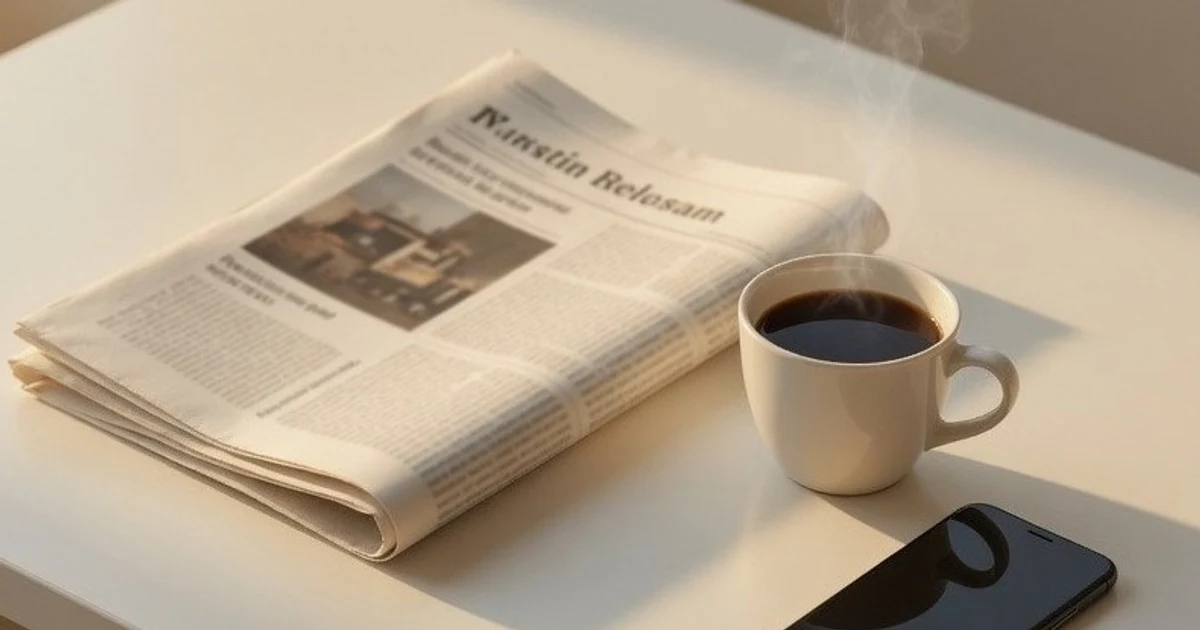
A morning news routine works when it is 10 minutes on one surface that can end, and orientation, not opinion, is its only job. Pew Research Center's news platform fact sheet (September 2025) reports that 86% of US adults get news from a smartphone, computer or tablet at least sometimes, and 56% do so often.
Key takeaways
- Orientation is the only job of the first ten minutes: which two or three things are real, which one might need you, and which twenty can wait.
- Pew Research Center's September 2025 fact sheet: 86% of US adults get news on a smartphone, computer or tablet at least sometimes, 56% often; the routine has to be built on the device that causes the overrun.
- Five steps in order: phone face down until you are upright, one surface that already gathered the night, a pass that can end, decisions rather than coverage, then close it.
- The test is retention, not the clock: name three stories out loud without looking at the phone.
- The Reuters Institute's Digital News Report 2026 finds interest in news down 13 percentage points on average since 2021, with 25% of respondents now casual weekly users, up from 16% — what an overrunning morning eventually produces.
A morning news routine should give you the day, not take it. The gap between ten minutes and forty is almost never the news itself — it is which surface you opened first and whether that surface was capable of ending. The Reuters Institute's 2026 Digital News Report describes news organizations reporting around the clock and jostling for a share of the four to five hours a day people spend on their smartphones. The morning is the most winnable slice of that. What follows is a routine for ordinary weekdays; it does not cover evening reading, and it does not tell you which newsrooms to trust.
What is a morning news routine for?
A morning news routine has one job: orientation. What moved overnight, what needs a decision from you today, and what can wait until this evening or until never.
It is not for having an opinion before breakfast, and it is not for clearing every alert that landed while you slept. Orientation is a smaller ambition than "being informed," which is exactly why it is achievable before 8 a.m. You are not trying to arrive at the first meeting having metabolized the world. You are trying to arrive knowing which two or three things are real, which one might need you, and which twenty can wait. That is a briefing, and briefings are allowed to be short.
The older objects were better at this than we usually admit. A newspaper had a physical size. A radio bulletin had a clock. You could be late for either and it still ended without you. The phone replaced both with something permanently unfinished, and then that object was placed on the nightstand.
What ruins the first ten minutes of the morning?
The damage is done by the choice of surface, not by any particular story. Four habits account for most of it, and none of them requires you to be weak-willed.
You open the noisiest surface because it is the nearest. The lock screen, a social feed, an app that treats overnight publishing as an emergency. Nearest is not the same as best. The nearest surface is the one engineered to survive on a nightstand.
You start reading before you are upright. Take this as advice rather than physiology: a session that never visibly starts is a session with nothing to end it. "I sat down to do this" gives a pass a shape. "I am still here" does not.
You let notifications write the agenda. A genuine emergency will find you. Everything else is a bid for the most valuable attention you own — the still-unspent kind. If the badge speaks first, the inventory chose the news and you did not.
You stack surfaces. The news app, then the newsletter, then the group chat that forwards headlines. Each feels like a small extra. Together they are the hour.
There is a structural reason this is difficult. Pew Research Center's news platform fact sheet, published in September 2025, reports that 86% of U.S. adults get news at least sometimes from a smartphone, computer or tablet, and 56% do so often. The phone is not one path into the news; it is the path. Whatever habit you build has to be built on the device that is also the problem.
What does a ten-minute morning pass look like, step by step?
Five steps, in order, and the order matters more than the content.
- The phone stays face down until you are upright. Water, light, the start of coffee. Two minutes. This is not a ritual, it is a refusal to let the lock screen write the first paragraph of your day.
- Open one surface that has already gathered. Not four homepages. One place that collected the night while you slept. What a news aggregator is sets out how that gathering works and what to ask of it; the short version is that you should not be doing the collecting yourself with a wet brain.
- Take a pass that can end. A newsletter ends. A printed page ends. A fixed batch of cards ends. A home-screen feed cannot. If your current morning news routine runs on a surface with no last item, the routine is already leaking.
- Make decisions, not coverage. For each story, ask one question: is this mine today? If yes, open the publisher's page and read it as a page. If no, move on. Do not hold a seminar with yourself about whether a serious person would care.
- Then close it. Not "close it and check the other app." Close it. The rest of the morning belongs to whatever the briefing was supposed to serve.
Ten minutes is a good target because it is long enough for more than the front page and short enough that it cannot become the morning. If you consistently need twenty, take twenty — but take them as twenty, not as ten that failed to stop.
How do you know the pass worked?
Use one test: while the kettle finishes, name three stories out loud without looking at the phone. If you can, you read. If you cannot, you scrolled.
The test is worth more than a timer because it measures retention rather than volume, and volume is the thing a morning quietly rewards. Adjust tomorrow rather than today, and adjust by subtraction. The wrong correction is to add a second surface to make up for a pass that did not stick; that turns a ten-minute problem into a twenty-minute one.
A slower signal is worth watching across a few weeks: whether the pass leaves you flatter than it found you. The Reuters Institute puts the share of people saying they are extremely or very interested in news down an average of 13 percentage points since 2021 across the markets it surveys, with a quarter of respondents (25%, up from 16% in 2021) now casual or passive users who consume news about once a week. Avoidance is what a morning that keeps overrunning eventually produces, and it arrives as boredom rather than as a decision. Why news fatigue is real is the longer account of that mechanism.
What should follow it, and what should not?
A good pass is allowed to leave a residue — a story can follow you onto the train. What should not follow you is the format: the sense that there is still a list, still a badge, still one item you might have missed.
Three rules for the rest of the morning.
Do not re-open to see what else landed. Something did. Something always did. That is not a reason.
Give a real story a later slot. A proper read at lunch beats a panicked skim at 7:40. The morning pass is triage; depth gets a chair of its own.
Protect the first conversation of the day. Reciting headlines is not the same as telling someone something. If you cannot say a story in two sentences without the phone in your hand, you passed through it rather than finished it.
If your interests run abroad, the morning is the wrong place to chase them. By 7 a.m. in the United States, much of Europe and Asia has already put in a working day, which can make an American morning feel behind before it starts. It is not behind. It is on time for your life. Widen the lens deliberately, in a slot you choose, instead of extending the pass until it has to cover the planet.
Offline reading is part of the after on some mornings. A pass taken on the way into a subway or a flight only finishes if the cards are already on the device. Whether news apps work offline is a separate question, and worth asking of anything you plan to trust at 6:30.
Decide the rule on a calm Sunday rather than at 6:50 on a Monday with a badge on the screen. One surface, one pass, then close. If you break it, do not schedule a punitive catch-up session in the evening — that is how a firehose gets a second shift. Do the pass again tomorrow.
GetMyNews is free on Google Play for Android, and it was built to be this kind of pass rather than a place to live: public feeds from 37 US newsrooms, batches of about 20 cards that finish, no account to create.
FAQ
Should you read the news before or after breakfast?
After, if you can arrange it. Reading before breakfast usually means reading in bed, and a session with no visible start rarely gets a visible end. Making coffee or sitting down at a table first gives the pass an edge, which is what keeps ten minutes from becoming forty. The order matters more than the clock: upright first, oriented second, then the day.
Do news notifications belong in a morning routine?
No, and they are the easiest thing on this page to remove. A breaking-news alert is a decision made by a publisher's growth team about when you should be interrupted, and it lands before you have chosen anything. Turn the alerts off, keep the pass, and let the morning's agenda come from a surface you opened on purpose rather than one that opened itself.
- world news
- product
- media literacy